
**InterLink Network Explained: Can Human Verification Become the Foundation of the Next Web3 Economy?
By @hitpaal | For BSCNews
For years, blockchain has struggled with one persistent challenge:
How do you prove that an on-chain user is a real human rather than a bot?
As artificial intelligence, automated accounts, and Sybil attacks become increasingly sophisticated, this question has evolved from a technical concern into one of Web3's biggest infrastructure challenges.
InterLink Network believes it has an answer.
Rather than competing solely as another blockchain or payment network, the project is positioning itself as a human-first blockchain ecosystem, where verified people—not automated identities—form the foundation of the network.
Here's a closer look at what InterLink Network is building and why it is attracting attention across the Web3 industry.
Building a Blockchain Around Real Human Identity
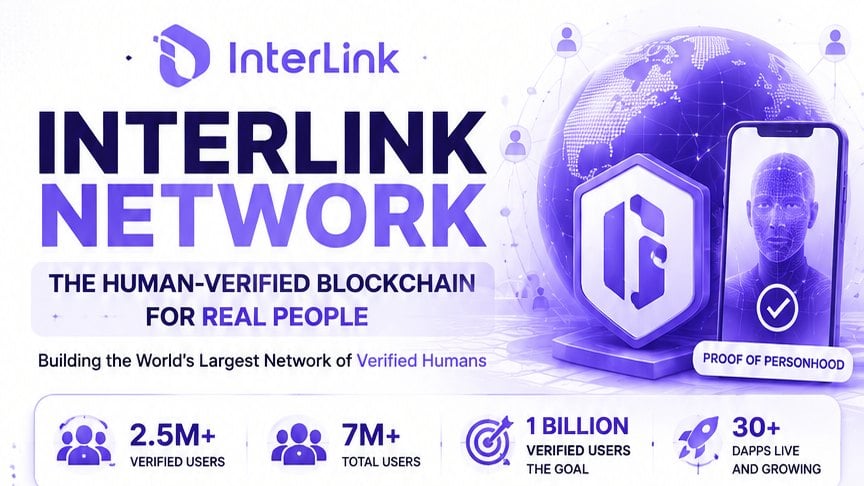
At its core, InterLink Network is designed around Proof of Personhood.
Instead of relying only on wallet addresses or traditional KYC processes, users complete a facial verification and liveness check through the application. The system then creates a zero-knowledge proof that confirms uniqueness without storing raw biometric information on-chain.
The objective is ambitious:
Create the world's largest decentralized network of verified humans.
As of mid-2026, the ecosystem reports more than 7 million registered users, including over 2.5 million verified participants, with a long-term vision of reaching one billion verified users.
If achieved, such a network could become an important identity layer for decentralized applications across multiple industries.
A Multi-Chain Infrastructure Designed for Scale
InterLink is not limited to a single blockchain ecosystem.
Its modular architecture supports interoperability across major networks including:
Ethereum
BNB Chain
Solana
Polygon
Tron
This cross-chain approach allows developers to build applications while maintaining compatibility with multiple blockchain environments.
The ecosystem has already expanded beyond infrastructure, with more than 30 decentralized applications available and a growing focus on practical utility rather than speculative activity.
Human Nodes: Mining Built Around Verified Users
Unlike traditional mining models that prioritize computing power, or mobile mining systems focused primarily on participation, InterLink introduces Human Nodes.
Only verified individuals are eligible to participate in mining and network rewards.
The approach is designed to reduce:
Fake accounts
Bot farms
Sybil attacks
Duplicate identities
By tying participation to unique human verification, the network aims to improve fairness while strengthening governance and ecosystem security.
Payments and Real-World Assets
During 2026, InterLink shifted significant attention toward payments and real-world economic activity.
Its latest roadmap highlights support for:
Merchant payments
Real-World Assets (RWA)
WalletConnect Pay integration
QR-code payments
Gift card purchases for shopping, gaming, and dining
Rather than positioning tokens purely as speculative assets, the project describes them as Transaction-Backed Digital Assets, intended to derive utility from genuine commercial activity.
This reflects a broader industry trend where blockchain networks increasingly focus on practical financial infrastructure.
A Dual-Token Economy
InterLink employs a two-token model.
$ITLG
The primary ecosystem token used for:
Governance
Human Node rewards
Mini-app payments
The total supply is 100 billion tokens, with 80% allocated to verified Human Node participants.
$ITL
A separate token designed for:
Institutional liquidity
Exchange listings
External payment infrastructure
Reserve functions
The supply is fixed at 10 billion tokens.
The ecosystem also incorporates token burns alongside as many as 100 halving events, creating long-term deflationary mechanics.
Strategic Partnerships
InterLink has highlighted collaborations and ecosystem relationships involving organizations such as:
Google for Startups
AWS
Visa
Mastercard
NYSE
NIST
These relationships demonstrate an ambition to connect blockchain infrastructure with established technology and financial ecosystems, although the long-term impact will depend on successful execution and continued development.
Comparing InterLink Network and Pi Network
Although both projects emphasize mass adoption, they approach the challenge differently.
Pi Network InterLink Network
Mobile-first mining ecosystem Human-first identity blockchain Phone verification followed by KYC Facial verification with liveness checks Focus on digital payments and ecosystem growth Focus on identity, payments, and RWA Single PI token Dual-token economy ($ITLG and $ITL) Open Mainnet utility expansion Global identity network and exchange ambitions
Rather than replacing one another, the two projects are attempting to solve different problems within Web3.
Major Developments in 2026
Several milestones have shaped InterLink's recent progress:
Launch of the Taj Mahal Testnet to evaluate scalability and transaction finality.
Introduction of its first dApp incubation program, signaling a stronger focus on developers.
Expansion of merchant payment capabilities through gift card integrations.
Continued discussions surrounding aspirations to become a crypto-native company pursuing a U.S. stock exchange listing.
These developments suggest the project is transitioning from infrastructure building toward ecosystem expansion.
The Bigger Picture
InterLink Network is pursuing a vision that extends beyond cryptocurrency trading.
Its broader objective is to create a trusted identity infrastructure capable of supporting:
Peer-to-peer payments
Humanitarian aid distribution
Ethical data ownership and compensation
Financial inclusion for unbanked populations
Real-world asset tokenization
If blockchain adoption increasingly depends on distinguishing real users from automated actors, identity verification could become a critical layer of future Web3 infrastructure.
Final Thoughts
InterLink Network represents one of several emerging projects attempting to address one of blockchain's most persistent challenges: establishing trust in decentralized environments.
Its combination of Proof of Personhood, cross-chain architecture, payment infrastructure, and dual-token economics differentiates it from many existing blockchain ecosystems.
However, like many early-stage Web3 projects, its long-term success will depend on sustained user adoption, regulatory developments, ecosystem growth, and the ability to deliver meaningful real-world utility.
Whether InterLink ultimately becomes a foundational identity layer for Web3 remains to be seen, but its approach reflects an increasingly important direction for the blockchain industry—building networks designed not just for wallets, but for verified human participation.
Disclaimer: This article is for informational purposes only and should not be considered financial or investment advice. Digital asset investments carry significant risk, and readers should conduct their own research before making financial decisions.**