
Disclaimer The future-oriented scenario outlined in this article does not claim to represent Pi Network’s official roadmap, confirmed development plans, or any official strategy. It is based solely on independent research, observations, personal experience, and creative foresight. All elements described constitute one possible speculative vision and personal conceptual exploration.
A Speculative Exploration of PiDex: Nationally Pegged Stable Tokens and Their Potential Implications for Liquidity and Ecosystem Dynamics
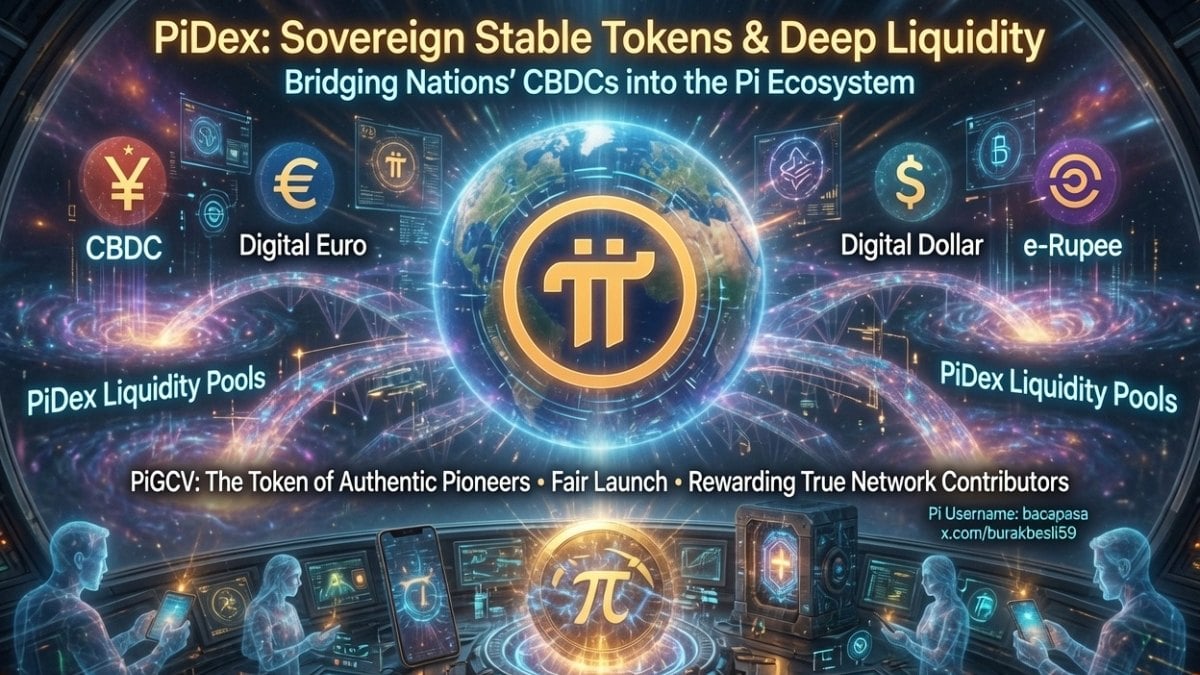
As the Pi Network ecosystem continues to develop its decentralized infrastructure, one can envision PiDex maturing into a sophisticated decentralized exchange capable of supporting advanced token swaps, automated market maker (AMM) functionality, and dynamic liquidity pools. Within this forward-looking context, a particularly compelling area of conceptual exploration involves the potential emergence of stable tokens pegged to sovereign digital currencies and Central Bank Digital Currencies (CBDCs). In this speculative framework, one could imagine the creation of ecosystem-native stable tokens such as pi-eCNY (conceptually aligned with China’s digital yuan), pi-DEUR (tied to the Digital Euro), pi-DINR (aligned with India’s e-Rupee), and comparable instruments for other jurisdictions. These assets might be developed through innovative initiatives within or inspired by the broader Pi ecosystem, leveraging its underlying blockchain capabilities to enable secure and interoperable digital representations of national currencies. Such tokens could theoretically serve as efficient bridges between traditional financial systems and decentralized environments, potentially facilitating cross-border payments, remittances, and commercial transactions while offering the relative price stability associated with sovereign digital currencies.
Liquidity Pools: Scaling Toward Greater Depth in a Hypothetical Adoption Scenario
In a hypothetical future where PiDex expands its capabilities, liquidity pools involving these stable tokens — such as PI/pi-eCNY pairs or cross-stable combinations — would likely begin with community-driven liquidity provision. The ultimate depth of these pools would depend significantly on the level of real-world adoption and transactional usage. Should governments, financial institutions, or large user bases begin to explore integration of these tokens for payments or settlements, transaction volumes could increase substantially. Higher volumes would, in turn, incentivize additional liquidity providers seeking competitive fee revenue. This dynamic could lead to progressively deeper pools, reduced price slippage on larger trades, and greater overall market efficiency. In optimistic scenarios involving meaningful national or institutional adoption, certain pools could accumulate significant total value locked, supporting more robust trading activity and attracting broader participation from both retail and institutional actors.
Potential Effects on Circulating Pi Supply and Price Dynamics
The conceptual integration of nationally pegged stable tokens into PiDex could carry several implications for Pi’s circulating supply and market behavior: •Demand Dynamics: Active participation in advanced PiDex functionalities — including swaps, liquidity provision, and fee payments — would require Pi as the native asset. In this model, stable tokens could position Pi as a potential gateway or intermediary asset within the ecosystem. •Liquidity Provision Effects: Participants contributing to pools would typically allocate Pi alongside stable tokens. This activity could temporarily reduce the volume of Pi in active circulation while generating yield opportunities for providers. •Holder Behavior and Utility: Expanded real-world utility for payments and decentralized finance activities might encourage longer-term holding or staking of Pi within the ecosystem, potentially moderating immediate sell pressure compared to purely speculative environments. •Price Discovery and Stability Considerations: Deeper liquidity combined with genuine utility could support more efficient price discovery. The availability of stable pairs might also provide natural hedging mechanisms, contributing to more balanced price movements as the ecosystem grows. Collectively, these factors could create a reinforcing cycle in which broader adoption supports liquidity formation, enhanced liquidity improves usability, and increased utility contributes to the perceived value of Pi as a core ecosystem asset.
PiGCV: A Conceptual Proposal for Contribution-Based Token Allocation
Building upon the principles of fair participation and long-term ecosystem alignment explored above, one personal conceptual proposal involves a token designated PiGCV (Pi Genesis Contributor Vault). Under this hypothetical framework, let x represent the quantity of Pi tokens genuinely earned through on-application mining activity within a given wallet (determined via a verified snapshot reflecting authentic early network participation). Acquisition of PiGCV would occur exclusively through participation in a dedicated launchpad mechanism. Eligible participants would be able to acquire up to x units of PiGCV, with allocation scaled directly to their verified mined Pi holdings. A defining feature of this conceptual design is that Pi obtained through centralized exchanges, secondary markets, bank transfers, or other non-mining sources would not count toward an individual’s allocation cap. Only Pi originating from the wallet holder’s own mining activity would qualify. This structure could conceptually establish a distinct category of “Genesis Holders” — participants whose sustained mining activity contributed to the network’s early growth and security. In this vision, PiGCV might offer utility such as governance participation in ecosystem decisions, preferential or enhanced access to new liquidity features, staking advantages, or other platform-specific benefits. The underlying rationale is to emphasize recognition of genuine contribution while promoting fairness in distribution. By anchoring eligibility to organically mined Pi, such a mechanism could encourage sustained engagement from early participants, including potential long-term liquidity provision in stable token pools. This, in turn, could support deeper and more resilient liquidity across the ecosystem. This article presents a single speculative and conceptual perspective. It is intended for thoughtful consideration and discussion rather than as definitive guidance or factual reporting. All projections remain hypothetical and subject to the inherent uncertainties of future technological and economic developments.
----------a gnssPioneer --- <B.B> @burakbesli59 on the X platform.