
Beyond the Button: Why Pi Network May Be Building the Infrastructure Before the Economy
An Opinion by @hitpaal
Several years ago, Dr. Nicolas Kokkalis shared a vision that many Pioneers still remember.
One day, he imagined, people might see a "Pay with Pi" button on a global e-commerce platform such as Amazon.
At the time, many dismissed the idea.
Some laughed.
Others argued that such a future was impossible.
But perhaps the conversation has always been focused on the wrong question.
Instead of asking "When will a major company accept Pi?", perhaps we should be asking "What infrastructure would a global company require before accepting any new digital currency?"
That distinction changes everything.
Looking Beyond Price
Much of the cryptocurrency industry revolves around market prices, exchange listings, and speculation. While those topics often dominate headlines, they do not necessarily create long-term utility.
Large technology companies operate differently.
Before integrating a payment system, they require secure user identity, trusted accounts, developer ecosystems, scalable infrastructure, fraud prevention, and reliable authentication.
Payments are rarely the first step.
Infrastructure usually comes first.
This is where Pi Network becomes particularly interesting.
A Pattern That Is Becoming Harder to Ignore
Over recent years, Pi Network has continued expanding its ecosystem with technologies that appear to strengthen its underlying digital infrastructure.
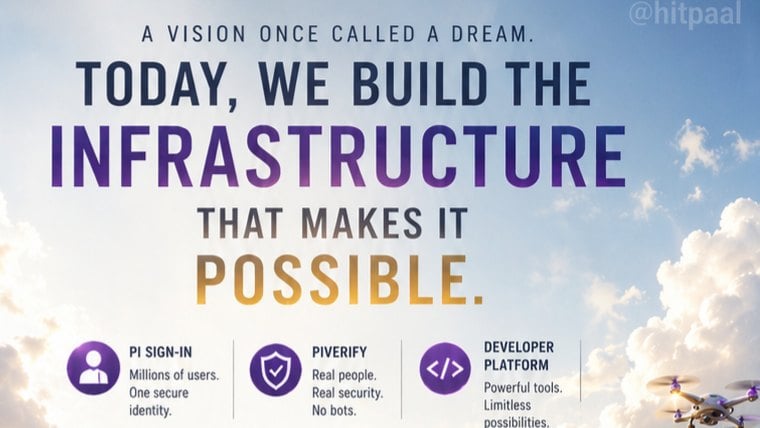
Pi Sign-In simplifies authentication by allowing applications to onboard verified Pi users more easily.
PiVerify provides businesses with additional confidence that they are interacting with genuine individuals rather than automated accounts.
Developer tools continue evolving, giving builders more opportunities to create utilities, applications, and services throughout the ecosystem.
Viewed individually, these features may appear incremental.
Viewed together, they begin to reveal a larger architectural strategy.
Identity.
Trust.
Security.
Developer enablement.
Infrastructure.
These are not merely software features.
They are foundational layers required for any digital economy that hopes to operate at global scale.
Infrastructure Is Often Invisible
History shows that transformational technology is frequently built long before the public notices it.
The internet required communication protocols before websites flourished.
Cloud computing required data centers before businesses migrated online.
Mobile ecosystems required operating systems and developer frameworks before millions of applications became possible.
Users often see the final product.
Engineers spend years building everything underneath it.
Perhaps Pi Network is following a similar path.
Why This Matters
If millions of verified users, secure authentication systems, developer tools, and business verification continue improving, the conversation gradually shifts.
Instead of asking whether Pi can process payments, observers begin asking whether Pi has built an ecosystem capable of supporting real digital commerce.
Those are two very different questions.
A payment button alone creates little value.
An ecosystem supporting identity, trust, applications, and commerce creates entirely different possibilities.
The Amazon Conversation
Whenever Amazon is mentioned alongside Pi Network, opinions quickly become polarized.
Some immediately assume integration is imminent.
Others reject the idea completely.
Reality is probably somewhere in between.
There is currently no public evidence that Amazon intends to integrate Pi Network.
However, that does not make the broader discussion meaningless.
The more interesting question is whether Pi Network is building the type of infrastructure that large enterprises generally expect before considering new technologies.
From that perspective, the discussion becomes less about one company and more about technological readiness.
A Builder's Economy
One of Pi Network's most important long-term ambitions may not simply be creating another cryptocurrency.
It may be creating an economy where developers, businesses, merchants, creators, and users interact within a trusted digital environment.
Such an economy depends on much more than transactions.
It depends on verified identities.
Secure authentication.
Developer innovation.
Business confidence.
Scalable infrastructure.
Those elements create the conditions under which digital commerce can flourish.
The Long Game
The crypto industry often rewards speed.
Pi Network appears to reward patience.
Its development approach has frequently emphasized ecosystem building over rapid expansion.
That strategy has attracted both criticism and support.
Yet infrastructure projects are rarely measured in weeks or months.
They are measured in years.
If the current direction continues, today's foundational technologies may eventually support opportunities that are difficult to imagine today.
Final Thoughts
Perhaps the famous "Pay with Pi" statement was never primarily about a payment button.
Perhaps it was about everything required to make such a button meaningful.
Whether Pi ultimately reaches that vision remains uncertain.
No one can predict which global companies may adopt future technologies or when.
But one observation seems increasingly worth considering:
The strongest digital economies are rarely built from payments alone.
They are built upon identity, trust, developers, infrastructure, and real utility.
If Pi Network continues strengthening those foundations, today's quiet infrastructure could become tomorrow's visible economy.
And perhaps, years from now, people won't remember the moment a payment button appeared.
They'll remember the years spent building the technology that made it possible.
— @hitpaal