
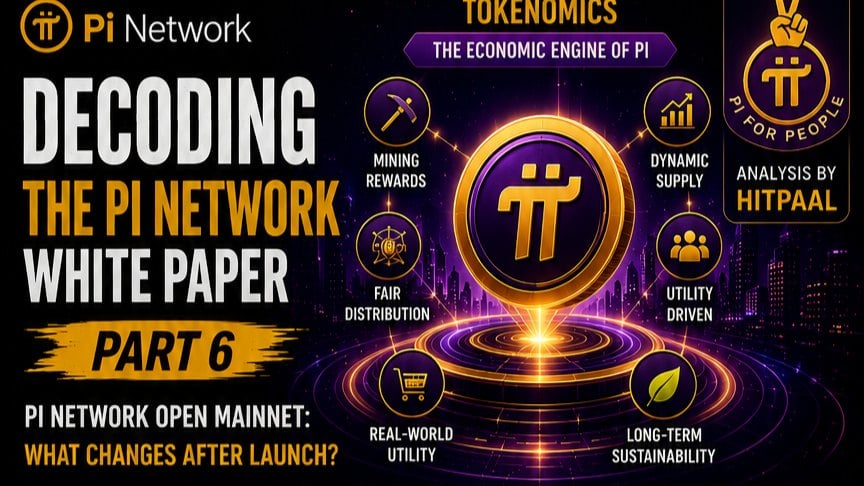
Pi Network Whitepaper Decoded – Part 6
Pi Network Open Mainnet: What Changes After Launch?
An Opinion by @hitpaal for BSCN
«"Launching a blockchain is not the finish line—it is the beginning of its real test. For Pi Network, Open Mainnet represents the transition from building a community to building a functioning digital economy."»
Introduction
For years, Pi Network operated in an enclosed environment while building its infrastructure, growing its user base, and developing its ecosystem.
This period was never intended to be the project's final destination.
According to the Pi Network Whitepaper, the long-term objective has always been an Open Mainnet—a stage where the network can interact freely with the broader blockchain ecosystem while supporting real-world utility.
But what exactly changes when a blockchain enters Open Mainnet?
What Is Open Mainnet?
An Open Mainnet is the stage where a blockchain becomes fully accessible to the outside world.
Unlike a closed or enclosed network, an Open Mainnet allows broader interaction with external wallets, blockchain infrastructure, developers, and other compatible services.
It represents the transition from a controlled environment to an open decentralized ecosystem.
For Pi Network, this marks an important milestone in moving from network building toward ecosystem expansion.
Why Was There an Enclosed Mainnet?
The Whitepaper explains that building a decentralized economy involves more than simply launching a blockchain.
Before opening the network, several foundations needed to mature, including:
- Identity verification (KYC).
- Migration of mined balances.
- Ecosystem application development.
- Community growth.
- Network security.
The enclosed phase was intended to allow these components to develop before broader external connectivity.
What Changes in Open Mainnet?
As the network becomes open, the ecosystem is expected to evolve in several important ways.
Developers can continue building decentralized applications that serve real users.
Businesses may explore integrating Pi into products and services where appropriate.
Users gain greater flexibility in participating within the broader blockchain ecosystem, subject to applicable network policies and available infrastructure.
Most importantly, the network begins operating under real market conditions rather than within a restricted environment.
Utility Becomes More Important Than Mining
During Pi's early years, most attention focused on mining.
However, the Whitepaper consistently emphasizes that mining is only the initial distribution mechanism.
In an Open Mainnet environment, long-term value depends increasingly on utility.
Applications, digital marketplaces, peer-to-peer transactions, developer activity, and real economic participation become significantly more important than simply earning additional tokens.
The success of the ecosystem ultimately depends on whether people choose to use Pi rather than merely hold it.
The Importance of Ecosystem Growth
Technology alone cannot sustain a blockchain.
A successful ecosystem requires multiple participants working together, including:
- Developers building useful applications.
- Businesses accepting or integrating network services.
- Users actively participating in the economy.
- Infrastructure providers supporting network reliability.
The Whitepaper suggests that decentralization is strengthened not only by technology but also by a diverse and active community.
Challenges Ahead
Open Mainnet also introduces new responsibilities.
A public blockchain must demonstrate:
- Long-term security.
- Network stability.
- Sustainable economic activity.
- Developer adoption.
- User confidence.
These are challenges faced by every blockchain project, regardless of its consensus mechanism or community size.
The transition to Open Mainnet therefore represents the beginning of a much more demanding stage of development.
My Analysis
In my view, Open Mainnet is the point where Pi Network's ideas begin facing real-world evaluation.
Community growth, mining participation, and technical design have laid the foundation.
The next phase depends on whether developers build valuable applications, businesses find practical use cases, and users participate in a genuine digital economy.
Ultimately, the success of Open Mainnet will be measured not simply by technical achievement, but by real adoption and sustained utility.
Final Thoughts
Open Mainnet is more than a technical milestone.
It represents Pi Network's transition from building infrastructure to supporting an open blockchain ecosystem.
The Whitepaper presents this phase as the beginning of a long-term vision where decentralization, utility, and community participation work together to create sustainable value.
Whether that vision is fully realized will depend on continuous innovation, ecosystem growth, and real-world adoption over the years ahead.
Series Conclusion
With this article, we conclude the "Pi Network Whitepaper Decoded" series.
Across six parts, we explored Pi Network's vision, mining model, ecosystem, consensus mechanism, tokenomics, and Open Mainnet strategy as presented in the official Whitepaper.
Like any blockchain project, Pi Network should be evaluated through both its technological design and its real-world execution. The Whitepaper outlines an ambitious roadmap, but its long-term success will ultimately be determined by adoption, utility, decentralization, and continued development.
This article is Part 6 and the concluding chapter of the "Pi Network Whitepaper Decoded" series. It is an independent analytical opinion by @hitpaal for BSCN, intended to explain the official Pi Network Whitepaper in a simple, balanced, and in-depth manner.