
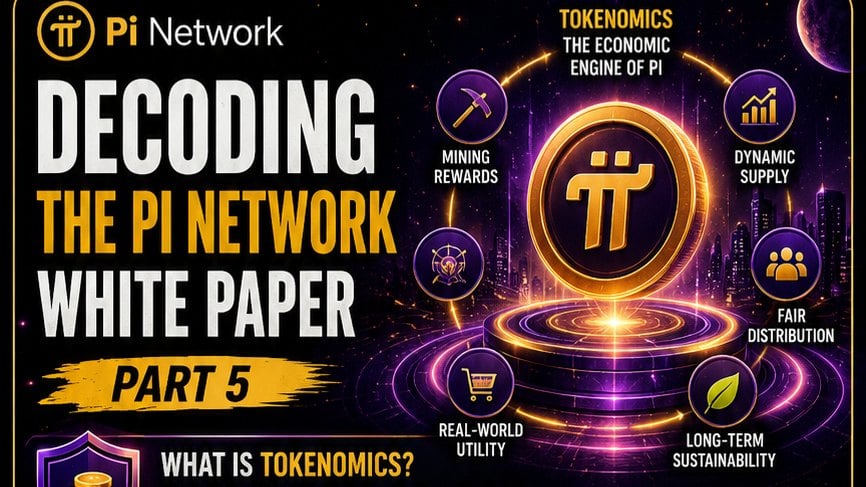
Decoding the Pi Network White Paper – Part 5
Pi Network's Tokenomics: Understanding Mining Rewards, Supply Model & Long-Term Sustainability
An Opinion by @hitpaal for BSCN Pioneer Brief
"A cryptocurrency's long-term success is determined not only by its technology, but also by its economic design. Pi Network's White Paper introduces a token model intended to reward meaningful contributions while supporting the network's long-term sustainability."
Introduction
Every blockchain has an economic system behind it.
That system determines how new coins are created, how they are distributed, and how the network balances growth with scarcity over time.
In the Pi Network White Paper, this economic framework is known as Tokenomics.
Rather than focusing solely on mining more coins, Pi's token model is designed to encourage ecosystem growth, utility, and community participation.
What Is Tokenomics?
Tokenomics refers to the economic rules governing a digital currency.
It answers important questions such as:
- How are new Pi coins issued?
- Who receives newly created Pi?
- What incentives encourage users to contribute?
- How can the network remain sustainable over the long term?
These principles influence both network participation and the future circulation of Pi.
Mining Rewards with a Purpose
Unlike traditional Proof-of-Work cryptocurrencies, Pi Network's mining process is designed to reward different forms of contribution.
According to the White Paper, rewards may be associated with activities such as:
- Daily participation.
- Building trusted security circles.
- Running nodes.
- Contributing to ecosystem development.
- Supporting network growth.
The objective is to reward value creation rather than raw computing power.
A Dynamic Supply Model
Pi Network does not present mining as an unlimited process.
Instead, the White Paper describes a reward structure that evolves as the network matures.
As participation increases, mining rewards are designed to gradually decrease, helping limit the rate at which new Pi enters circulation.
This approach seeks to balance early incentives with long-term sustainability.
Scarcity and Sustainability
For any digital currency, scarcity plays an important economic role.
If new coins are created without limits, maintaining long-term value becomes increasingly difficult.
Pi's economic design attempts to balance three objectives:
- Fair distribution.
- Sustainable issuance.
- Long-term ecosystem growth.
Ultimately, the success of this model depends on real-world adoption and utility, not issuance alone.
Why Utility Matters More Than Supply
Token supply alone does not determine value.
Even a limited supply has little significance if there is insufficient demand or practical use.
The White Paper consistently emphasizes that the future of Pi depends on:
- Active developers.
- Businesses accepting Pi.
- Useful applications.
- Everyday transactions.
- A thriving digital economy.
Utility transforms a digital asset from something people simply hold into something they actively use.
My Analysis
In my view, Pi Network's tokenomics reflect a long-term philosophy rather than a short-term mining strategy.
The White Paper emphasizes rewarding participation and encouraging ecosystem development instead of maximizing coin production.
However, tokenomics alone cannot guarantee success.
The real test will be whether the ecosystem generates sufficient demand and utility to support a sustainable digital economy over time.
Final Thoughts
A blockchain's economic model is as important as its technology.
Pi Network's White Paper presents tokenomics as a mechanism for encouraging participation, supporting ecosystem growth, and promoting long-term sustainability.
Whether this model ultimately succeeds will depend on execution, adoption, and the creation of meaningful real-world utility.
Coming Next...
Part 6: Utility Creates Value: Why Pi Network Believes Real-World Use Is More Important Than Market Speculation.
We'll explore why the White Paper places utility at the center of Pi's vision and how applications, businesses, and everyday transactions could shape the future of the ecosystem.
This article is Part 5 of the Decoding the Pi Network White Paper series. It is an independent analytical opinion by @hitpaal for BSCN Pioneer Brief, intended to explain the official Pi Network White Paper in a clear, balanced, and accessible manner.