
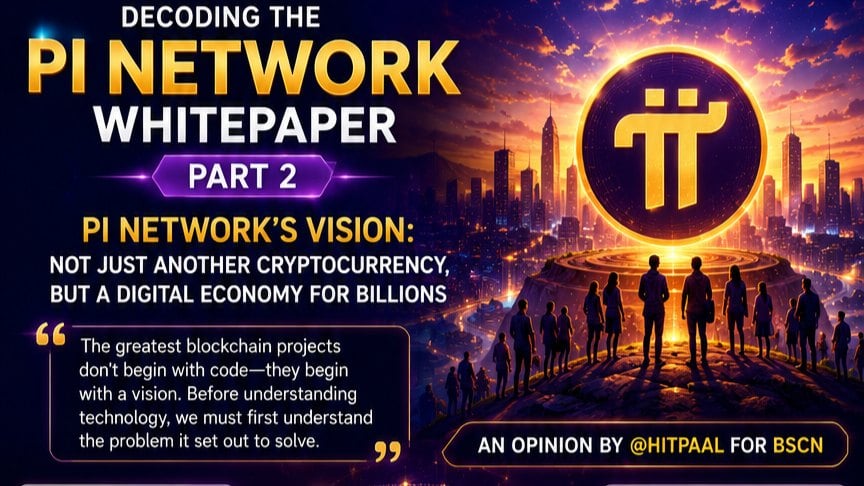
Decoding the Pi Network Whitepaper – Part 2
Pi Network's Vision: Not Just Another Cryptocurrency, But a Digital Economy for Billions
An Opinion by @hitpaal for BSCN
"The greatest blockchain projects don't begin with code—they begin with a vision. Before understanding Pi Network's technology, we must first understand the problem it set out to solve."
Introduction
When most blockchain projects introduce themselves, they begin by discussing technology—consensus mechanisms, scalability, transaction speed, or security.
Pi Network takes a different approach.
The opening chapter of its whitepaper doesn't start with algorithms or cryptography. Instead, it asks a fundamental question:
Why hasn't cryptocurrency become accessible to everyone?
That question shapes the entire philosophy behind Pi Network.
Rather than building a blockchain exclusively for developers, miners, or institutional investors, the Pi Core Team envisioned a network where participation is open to anyone with a smartphone.
Whether that vision can be fully realized remains an open question. But to understand Pi Network today, we must first understand the vision that inspired its creation.
The Vision According to the Whitepaper
The Pi Network Whitepaper presents a clear objective:
To build the world's most inclusive peer-to-peer digital ecosystem, powered by a cryptocurrency that is easy to access, easy to use, and ultimately useful in everyday life.
Unlike many early blockchain projects that prioritized technical performance, Pi places equal importance on accessibility and participation.
The whitepaper argues that cryptocurrency should not be limited to those with expensive mining hardware or deep technical expertise. Instead, it should empower ordinary people to become active participants in the digital economy.
This vision forms the foundation for every design decision discussed throughout the whitepaper.
More Than a Coin
One of the biggest misconceptions surrounding Pi Network is that it aims to be "just another cryptocurrency."
The whitepaper suggests something broader.
Pi is presented as the foundation for an ecosystem where digital currency supports applications, commerce, services, and peer-to-peer transactions.
In other words, the long-term goal is not simply to create a tradable asset, but to develop an economy where utility creates value.
This distinction becomes increasingly important as the whitepaper later discusses developers, businesses, decentralized applications, and real-world use cases.
Accessibility Before Complexity
Pi Network's founders argue that mainstream adoption requires removing barriers that have historically limited cryptocurrency participation.
According to the whitepaper, those barriers include:
Technical complexity
High hardware requirements
Significant energy consumption
Limited accessibility for everyday users
Pi's proposed solution is straightforward:
Make participation as simple as using a smartphone.
The idea is not merely about convenience—it is about lowering the entry barrier so that millions, and eventually billions, of people can participate in the digital economy.
Financial Inclusion at the Core
The whitepaper also frames Pi Network as a project with broader social ambitions.
Across the world, billions of people remain underserved by traditional financial systems. Pi argues that smartphones have become one of the most widely available technologies on Earth, creating an opportunity to expand access to digital financial participation.
Rather than viewing cryptocurrency solely as an investment, the whitepaper presents it as a tool that could help broaden economic participation through a globally accessible network.
This emphasis on financial inclusion distinguishes Pi's vision from many blockchain projects that focus primarily on technical innovation.
Community as Infrastructure
Perhaps the most distinctive element of Pi Network's vision is its emphasis on people.
Instead of relying solely on computational power, the whitepaper places community participation and social trust at the center of the network's architecture.
This philosophy later evolves into concepts such as Security Circles and the Stellar Consensus Protocol (SCP), both of which rely on trust relationships rather than energy-intensive mining.
For Pi, community is not simply a marketing strategy—it is part of the network's design.
Analysis
In my view, Pi Network's greatest innovation is not necessarily its technology—it is the way it reframes the adoption challenge.
The whitepaper asks an important question that remains relevant across the blockchain industry:
If cryptocurrency is too difficult for ordinary people to use, can it ever achieve true mass adoption?
Pi's answer is to prioritize accessibility, community, and utility from the very beginning.
Whether the project ultimately fulfills that vision will depend on continued ecosystem growth, meaningful real-world utility, and sustained community engagement.
Like any ambitious vision, success will be measured by execution.
Final Thoughts
Every blockchain begins with a vision.
Pi Network's vision is not simply to launch another digital currency, but to build a digital economy where participation is open, accessible, and meaningful for people around the world.
Years after the whitepaper was first published, that vision continues to shape discussions around Pi Network's progress and future.
Understanding this vision is essential before evaluating the project's technology, tokenomics, or long-term roadmap.
Coming Next
Part 3: The Problem Pi Network Set Out to Solve
Why did Pi's founders believe existing cryptocurrencies were not enough? What limitations did they identify, and how did those observations influence the network's design?
In the next installment, we'll examine the challenges that inspired Pi Network's creation.
This article is part of "Decoding the Pi Network Whitepaper," an independent opinion series by @hitpaal for BSCN, exploring Pi Network's official whitepaper through factual explanation, technical analysis, and balanced commentary.