
Here's a natural continuation for the series.
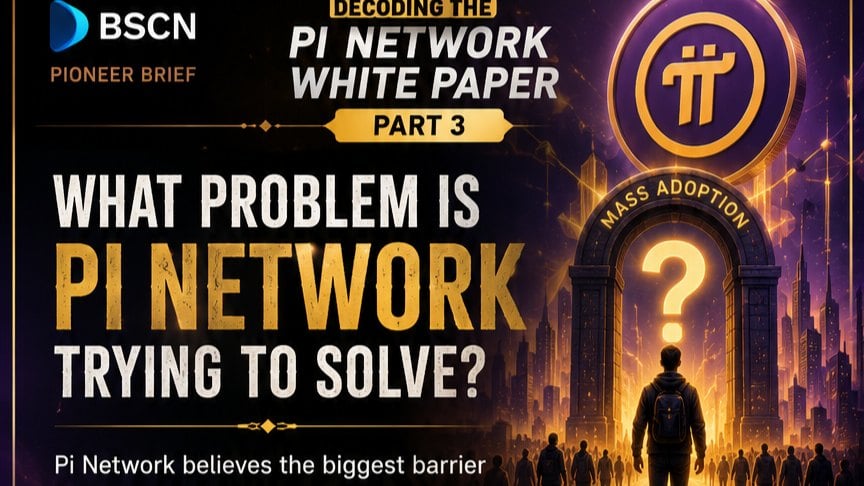
Decoding the Pi Network White Paper – Part 3
What Problem Is Pi Network Trying to Solve?
An Opinion by @hitpaal for BSCN
"Every successful innovation begins by identifying a real problem. Before proposing a solution, the Pi Network White Paper first asks a fundamental question: Why has cryptocurrency, despite more than a decade of development, not achieved true mass adoption?"
Introduction
Bitcoin introduced the world to decentralized digital money. Ethereum expanded blockchain into programmable applications. Thousands of cryptocurrencies followed.
Yet despite this innovation, cryptocurrency remains far from being a part of everyday life for most people.
The Pi Network White Paper argues that the greatest obstacle is not blockchain technology itself—it is accessibility.
According to the White Paper, cryptocurrency can only reach its full potential if it becomes simple enough for ordinary people to use in their daily lives.
The Adoption Gap
The White Paper identifies a significant gap between technological innovation and public adoption.
While blockchain technology has advanced rapidly, many barriers still prevent mainstream participation:
- Mining often requires expensive hardware.
- Many networks consume significant amounts of electricity.
- Wallets and private keys can be confusing for new users.
- High transaction fees can discourage everyday payments.
- Cryptocurrency is still viewed primarily as a speculative investment rather than a practical medium of exchange.
As a result, millions remain observers instead of participants.
Pi Network's Perspective
Pi Network believes that the next stage of blockchain evolution is not necessarily creating faster or more powerful technology.
Instead, it focuses on making blockchain easier for ordinary people to access and use.
Its philosophy is straightforward:
The easier it is to participate, the more likely global adoption becomes.
This belief influenced several key design choices, including mobile accessibility, simplified onboarding, identity verification, and a community-driven growth model.
Lowering the Barrier to Entry
Rather than asking people to purchase specialized mining equipment or learn complex technical concepts, Pi Network aims to reduce friction.
Its approach emphasizes:
- Smartphone-based participation.
- A simple and intuitive user experience.
- Building trust through verified human identities.
- Encouraging community engagement instead of competition for computing power.
The objective is to allow participation without requiring advanced technical knowledge.
From Users to Contributors
The White Paper suggests that participants should contribute to the network in different ways—not only through technology, but also through community building.
Users can help by:
- Growing the network.
- Verifying identities.
- Running nodes where applicable.
- Developing applications.
- Supporting real-world utility within the ecosystem.
The idea is that long-term value comes from collective participation rather than infrastructure alone.
Challenges Ahead
Identifying a problem is only the first step.
Successfully solving it requires continuous execution.
Pi Network still faces important challenges, including:
- Expanding real-world utility.
- Increasing developer participation.
- Encouraging business adoption.
- Building sustainable economic activity.
- Maintaining community trust over time.
Whether Pi ultimately succeeds will depend on how effectively it addresses these challenges in the years ahead.
My Analysis
In my view, Pi Network's strongest argument is that blockchain adoption is fundamentally a human challenge, not merely a technical one.
History shows that transformative technologies become mainstream only after they become simple enough for ordinary people to use.
If Pi can successfully combine accessibility with meaningful utility, it could broaden participation in digital finance. However, widespread adoption will ultimately depend on delivering practical value at scale, not vision alone.
Final Thoughts
The Pi Network White Paper suggests that the future of cryptocurrency will not be determined solely by faster blockchains or more advanced consensus mechanisms.
It may instead be shaped by which networks make decentralized technology accessible, useful, and relevant to billions of people.
Whether Pi achieves that ambition remains an open question, but its emphasis on lowering barriers to participation is one of the defining themes of its vision.
Coming Next...
Part 4: How Does Pi Network Work? Understanding Security Circles and the Stellar Consensus Protocol (SCP).
We'll explore how Pi Network secures its blockchain without relying on Proof of Work, why Security Circles exist, and how the Stellar Consensus Protocol forms the foundation of Pi's consensus mechanism.
This article is Part 3 of the "Decoding the Pi Network White Paper" series. It is an independent analytical opinion by @hitpaal for BSCN, intended to explain the official Pi Network White Paper in a clear, balanced, and accessible way.If you're publishing this as a series on BSCN, Parts 4–10 can progressively cover SCP, Security Circles, Nodes, Tokenomics, Utility, Open Network, AI integration, and the long-term roadmap in the same style.