
Decoding Pi Network's Consensus Engine: How FBA and SCP Could Shape the Future of Digital Trust
An Opinion by @hitpaal for BSCN Pioneer Brief
Beyond Mining: Understanding What Truly Powers Pi Network
When most people think about a blockchain, they think about price charts, mining rewards, or transaction speeds. Yet beneath every successful blockchain lies something far more important—its consensus mechanism. Consensus is the invisible engine that determines whether a network can remain secure, decentralized, and trustworthy without relying on a central authority.
Pi Network's vision has never been to replicate Bitcoin or compete directly with existing cryptocurrencies. Instead, it aims to build an inclusive digital economy where billions of people can participate using everyday devices. Achieving that vision requires a fundamentally different approach to consensus.
That approach is built upon Federated Byzantine Agreement (FBA) and implemented through the Stellar Consensus Protocol (SCP).
Together, these technologies represent one of the most innovative departures from traditional blockchain architecture.
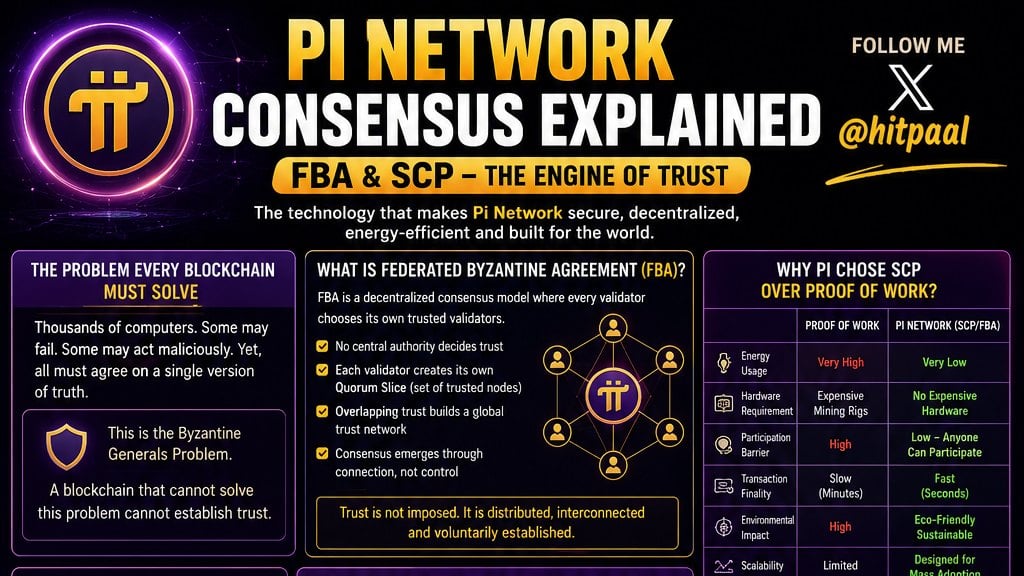
The Problem Every Blockchain Must Solve
Imagine thousands of computers spread across the world.
None of them know each other personally.
Some may fail.
Some may act maliciously.
Some may even attempt to manipulate transactions.
Yet every one of them must eventually agree on a single version of truth.
This challenge is known in distributed computing as the Byzantine Generals Problem, one of the most famous problems in computer science.
A blockchain that cannot solve this problem cannot establish trust.
Consensus is therefore not just a technical feature—it is the very foundation of decentralized systems.
What Is Federated Byzantine Agreement (FBA)?
Traditional consensus systems often rely on a predefined list of validators or on computational competition.
FBA takes a radically different approach.
Instead of asking, "Who controls the network?", it asks:
"Whom do you personally trust?"
Every validator independently selects a group of trusted validators known as its quorum slice.
These trust relationships overlap with one another, gradually forming a resilient global trust network.
Consensus emerges naturally through these overlapping relationships rather than through centralized control.
Trust is not imposed.
It is distributed, interconnected, and voluntarily established.
Quorum Slices: The Building Blocks of Trust
Consider a validator that trusts three other validators.
That small collection becomes its quorum slice.
Another validator may trust an entirely different group.
As long as these trust groups overlap sufficiently, the network can continue reaching agreement—even if some participants fail or attempt dishonest behavior.
The remarkable aspect of FBA is that no single authority determines trust.
The community collectively creates the trust graph.
This flexibility significantly enhances decentralization while reducing dependence on centralized governance.
From FBA to SCP: Turning Trust into Consensus
While FBA defines who participates in trust, the Stellar Consensus Protocol (SCP) defines how agreement is actually reached.
SCP transforms decentralized trust into deterministic consensus through carefully structured voting.
The process unfolds in several stages:
- Transactions are proposed to the network.
- Validators nominate valid transactions.
- Trusted validators exchange votes.
- Multiple voting rounds eliminate conflicts.
- Once sufficient agreement is achieved, the transaction is finalized permanently.
Unlike probabilistic systems, SCP offers fast finality.
Once consensus is reached, transactions are considered irreversible.
There is no waiting for dozens of additional confirmations.
Why Pi Network Chose SCP Instead of Proof of Work
Bitcoin introduced Proof of Work at a time when decentralized consensus seemed nearly impossible.
Its innovation changed history.
However, Proof of Work also introduced significant costs.
Massive energy consumption.
Specialized mining hardware.
Growing barriers to participation.
Pi Network pursued a different objective.
Rather than rewarding computational power, Pi seeks to reward participation, trust, and ecosystem growth.
By adopting SCP, Pi dramatically reduces energy consumption while enabling consensus through validator cooperation rather than computational competition.
This design aligns far more closely with Pi's mobile-first philosophy.
The Role of Security Circles
Security Circles are frequently misunderstood.
Many assume they directly validate transactions.
They do not.
Instead, Security Circles help establish trusted social relationships that contribute to Pi's broader trust graph.
Consensus itself is performed by desktop Pi Nodes running the SCP protocol.
The Security Circle simply provides a human layer of trust that complements the technical validator network.
This distinction is essential.
Mobile mining demonstrates ongoing participation.
Desktop nodes secure consensus.
Together, they reinforce Pi Network's decentralized architecture.
Why This Architecture Matters
FBA and SCP provide several compelling advantages.
Energy efficiency enables sustainability without sacrificing security.
Fast transaction finality improves user experience for payments and commerce.
Lower infrastructure requirements reduce barriers to participation.
Distributed trust minimizes dependence on centralized authorities.
Most importantly, consensus becomes accessible without requiring industrial-scale mining operations.
This creates an environment where ordinary users can become meaningful participants in securing the ecosystem.
Challenges That Should Not Be Ignored
No consensus mechanism is perfect.
FBA relies upon healthy and well-connected trust relationships.
Poor validator configurations can weaken resilience.
Network safety depends on sufficient overlap among quorum slices.
Long-term decentralization also requires a diverse validator ecosystem rather than concentration among a small number of trusted participants.
These challenges are not unique to Pi Network, but they highlight why thoughtful network growth remains critical.
More Than Technology—A Different Philosophy
The true innovation of Pi Network may not simply be that it uses SCP.
Its greater innovation lies in what that choice represents.
Rather than measuring contribution through electricity consumption, Pi attempts to measure it through participation, identity, and trusted relationships.
That philosophical shift could prove just as significant as the technical architecture itself.
If digital economies are ultimately built upon trust, then consensus mechanisms like FBA and SCP deserve far more attention than daily price fluctuations.
Technology creates infrastructure.
Trust creates economies.
Final Thoughts
History often remembers visible innovations while overlooking the invisible systems that make them possible.
Consensus is one of those invisible systems.
Every payment, every application, every smart contract, and every future service within the Pi ecosystem ultimately depends upon thousands of independent validators reaching agreement without centralized control.
Whether Pi Network fulfills its long-term vision remains a question only time can answer.
However, one fact is already evident:
Its consensus architecture represents one of the most thoughtful attempts to balance decentralization, scalability, sustainability, and accessibility for a global digital economy.
In the world of blockchain, trust is the ultimate currency.
FBA and SCP are the engines designed to protect it.
An Opinion by @hitpaal for BSCN Pioneer Brief