Code doesn't lie.
Recent on-chain analysis has revealed some interesting facts.
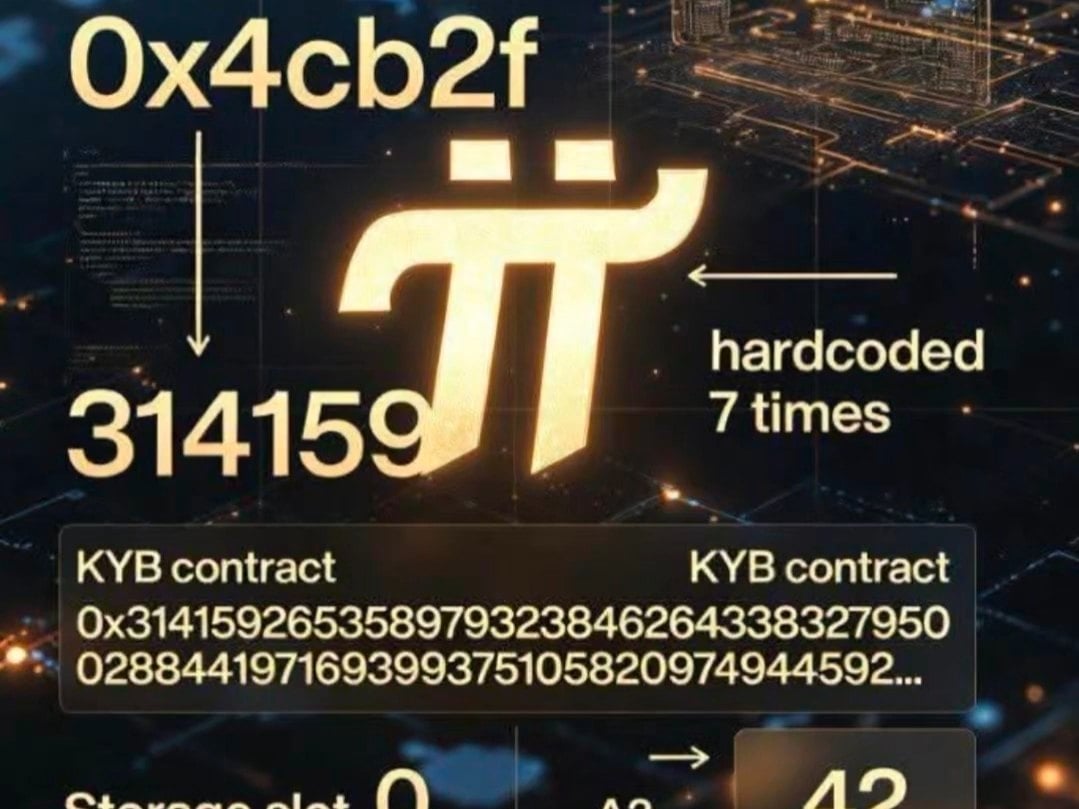
The hexadecimal (hex) value of "0x4cb2f" becomes 314159 when converted to decimal. This is exactly the same as 3.14159, the starting number of the pi (Pi) that everyone knows.
What is more noteworthy is that this value is hardcoded 7 times in the bytecode of the KYB smart contract starting with "0x314159...", and important storage slots 0 and 42 are also linked to this value.
Additionally, the smart contract address itself is in the form of a Vanity Address (specially generated address) created according to the number of pi, such as "0x314159265358979...".
These addresses are not created by chance, but are created intentionally by generating and repeatedly calculating numerous addresses.
In other words, this can be interpreted as an on-chain signature intentionally left by the developer rather than a simple coincidence.
Of course, this is not a direct basis for proving the value or future plans of a specific project.
However, it can be confirmed through on-chain data that at least the symbolism of Pi(π) was intentionally reflected in the code and address during the development process.
The biggest feature of blockchain is that all records are public and can be verified by anyone.
A person can change his or her opinion, but The code and on-chain data of deployed smart contracts cannot be easily changed.
Code doesn't lie.