
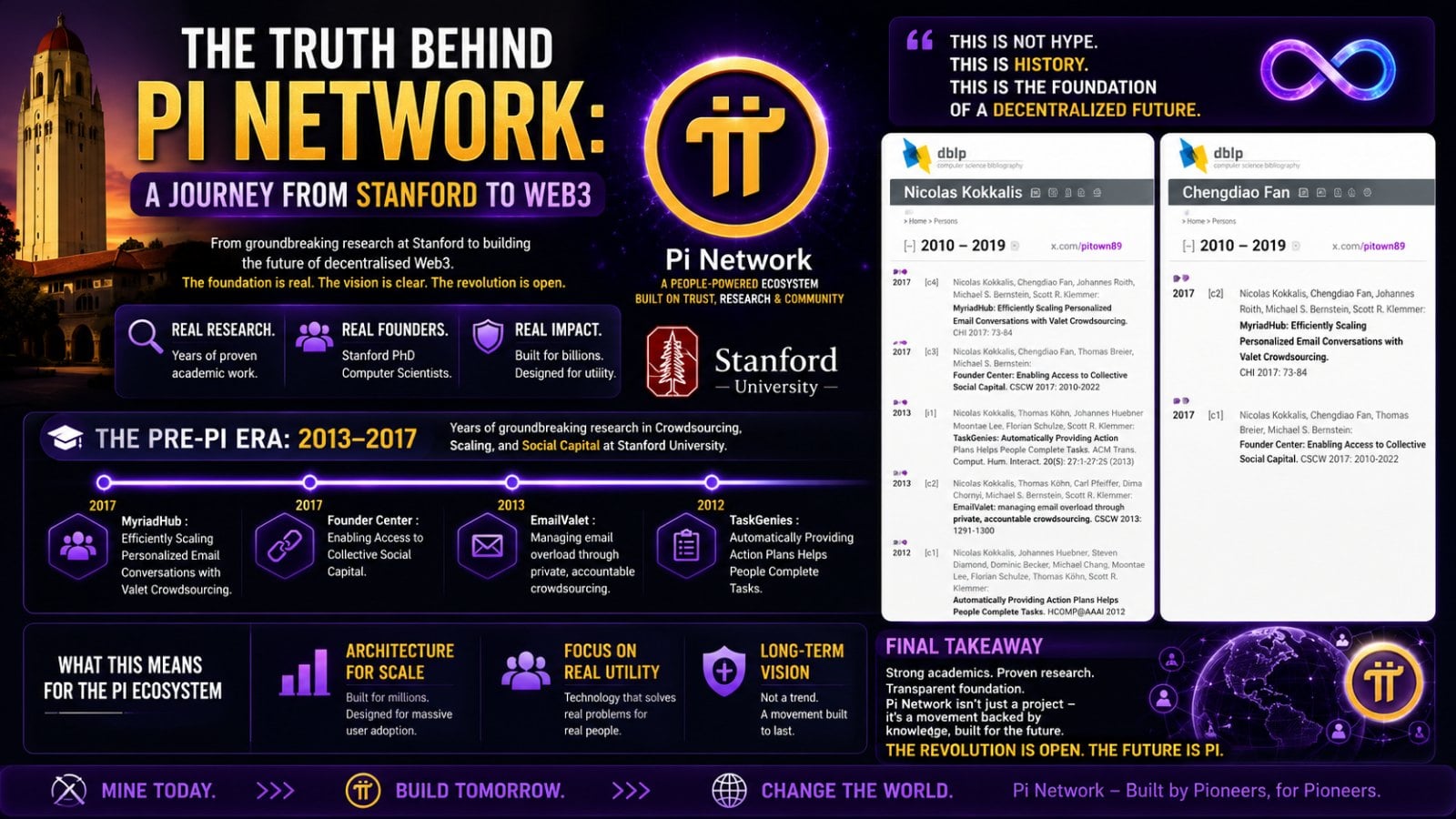
Every day in the world of Web3 and cryptocurrency, new projects launch, and just as many disappear. Most are run by anonymous teams or individuals with unverifiable technical backgrounds. But when it comes to an ecosystem used daily by millions of Pioneers, it's natural to ask—is its foundation truly solid? Recently, screenshots from the dblp (computer science bibliography) database surfaced, revealing the historical research timeline of Pi Network's core founders, Dr. Nicolas Kokkalis and Dr. Chengdiao Fan. Honestly, these details are enough to validate the confidence of any tech enthusiast or developer building in this space. Here, we decode what these screenshots actually mean and why they are so crucial for the future of the Pi ecosystem. 🧠 The Pre-Pi Era: The 2013-2017 Research Timeline People often assume Pi Network suddenly materialized as a concept in 2019. However, the data from the DBLP database tells a very different story. From 2013 to 2017, Dr. Nicolas and Dr. Fan were conducting groundbreaking collaborative research at Stanford University. Pay close attention to the focus of their research papers: MyriadHub (2017): Efficiently Scaling Personalized Email Conversations with Valet Crowdsourcing. Founder Center (2017): Enabling Access to Collective Social Capital. EmailValet (2013): Managing email overload through private, accountable crowdsourcing. Notice the pattern? "Crowdsourcing," "Scaling," "Social Capital." These weren't just abstract academic theories; they were the foundational blueprints for the decentralized, community-driven network we know today as Pi. Their deep expertise in Human-Computer Interaction (HCI) is the exact reason why Pi's interface is intuitive enough for anyone to seamlessly enter a crypto ecosystem without prior technical knowledge. 🛠️ What Does This Mean for Developers and the Ecosystem? For the everyday user, this data serves as verifiable proof of trust and transparency. But for the visionaries investing their time, logic, and effort into building on this network, it represents something much bigger. When you are architecting a utility-based dApp—whether it is a peer-to-peer skill exchange platform powered by crypto payments, a Web3 ride-sharing application equipped with secure escrow logic, or a hybrid marketplace for premium digital assets and wallpapers—that platform demands a rock-solid, scalable underlying infrastructure. The academic background of Pi's founders guarantees three critical things: Architecture for Scale: They have spent years analyzing large-scale systems and user interactions, meaning they understand how to handle the data and transaction volume of millions of users without network congestion. Focus on Real Utility: Their research has historically centered on making technology practically useful for everyday people. This aligns perfectly with the core philosophy of Pi Network—driving real-world utility over speculative trading. Long-Term Vision: This is not an overnight pump-and-dump project. Its foundation was systematically laid by computer scientists who have dedicated their careers to the mechanics of social computing. 🌐 The Final Takeaway In the crypto space, hype is temporary, but strong fundamentals sustain. These records from the dblp database prove that Pi Network stands on an incredibly robust academic and technical foundation. This ecosystem is far more than a mobile mining application; it is a scalable infrastructure designed for the next wave of Web3 adoption. And the best part? This revolution isn't being built behind closed doors, but out in the open, continuously evolving alongside the global Pioneer community. Building the future of Web3 requires patience, a clear vision, and a foundation of steel. The data shows that Pi has exactly that. 🚀
This post is user-generated content. The views and opinions expressed are solely those of the author and do not necessarily reflect the views of, and are not endorsed, verified, or sponsored by, BSC.News LLC.
Pi Network🚀 The Truth Behind Pi Network: A Journey from Stanford to Web3 🔍
Comments
00/1000
No comments yet.