
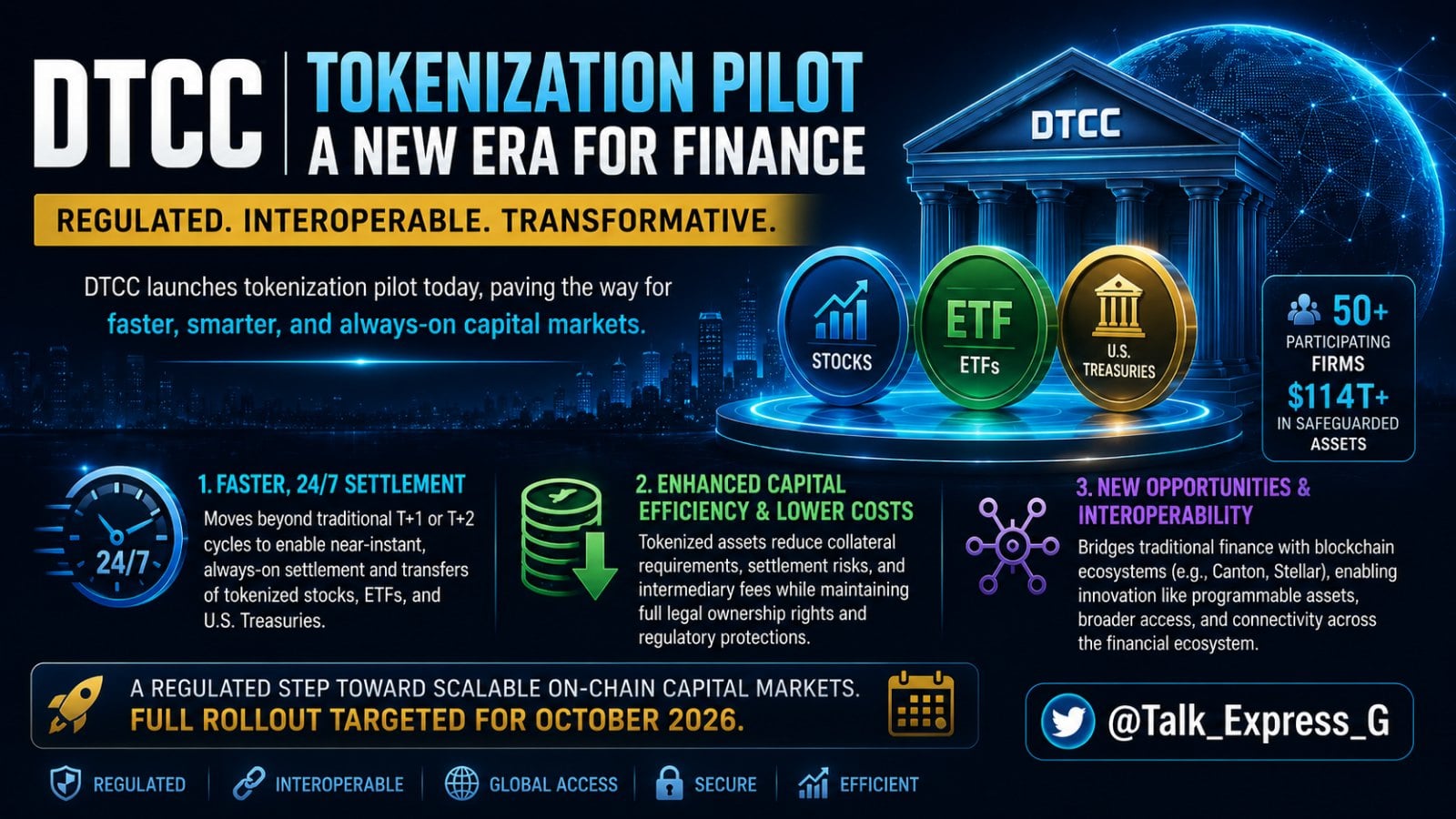
The financial world is taking another significant step toward blockchain adoption. Today, the Depository Trust & Clearing Corporation (DTCC) launched its tokenization pilot, signaling a move toward regulated, institutional-grade on-chain capital markets. As the world's largest securities clearing and settlement infrastructure—safeguarding over $114 trillion in assets—DTCC's involvement represents far more than a simple blockchain experiment.
- Faster, 24/7 Settlement
Traditional financial markets typically settle trades on a T+1 or T+2 basis, meaning investors often wait one or two business days for transactions to finalize. DTCC's tokenization initiative aims to replace this model with near-instant, 24/7 settlement for tokenized stocks, ETFs, and U.S. Treasuries.
This could:
Improve market liquidity.
Reduce settlement delays.
Enable continuous trading beyond traditional market hours.
Increase overall operational efficiency.
- Improved Capital Efficiency and Lower Costs
Tokenization streamlines financial infrastructure by reducing the need for multiple intermediaries. This can lead to:
Lower collateral requirements.
Reduced settlement risk.
Lower operational and transaction costs.
Faster movement of capital.
Importantly, investors still retain full legal ownership rights and regulatory protections, ensuring compliance while benefiting from blockchain technology.
- Connecting Traditional Finance with Blockchain
One of the most exciting aspects of the pilot is its focus on interoperability.
DTCC is exploring integration with blockchain ecosystems such as Canton and Stellar, creating bridges between traditional financial institutions and decentralized infrastructure.
More than 50 participating firms are expected to collaborate, opening the door to:
Programmable financial assets.
Automated settlement through smart contracts.
Broader global market access.
Cross-platform asset interoperability.
- A Regulated Path Toward On-Chain Capital Markets
Unlike many experimental blockchain projects, DTCC's initiative is being developed within an established regulatory framework. The goal is not to replace existing financial markets overnight but to modernize them while maintaining investor protections and compliance standards.
The pilot represents a measured and regulated transition toward scalable on-chain capital markets.
Looking Ahead
DTCC is targeting a broader rollout in October 2026. If successful, this initiative could become one of the most important milestones in the convergence of traditional finance and blockchain technology.
As institutions continue embracing tokenization, the future of finance is likely to become faster, more transparent, interoperable, and available around the clock. The shift from paper-based and delayed settlement systems toward real-time digital assets is no longer a distant vision—it's actively being built today.