
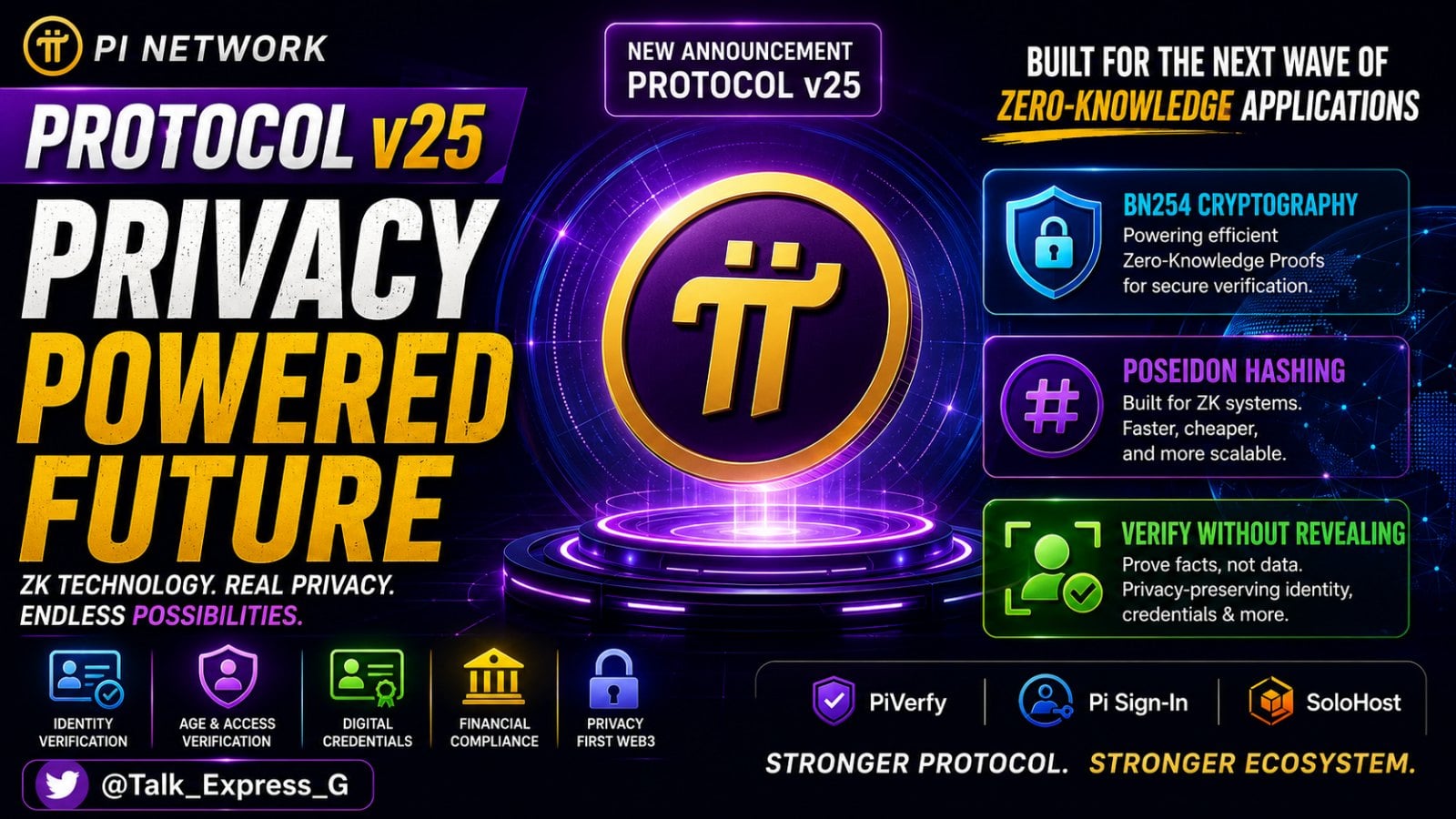
Pi Network has officially introduced Protocol v25, bringing two powerful cryptographic primitives—BN254 cryptography and Poseidon hashing—to the network. While these names may sound highly technical, they represent a foundational upgrade that prepares Pi Network for the next generation of decentralized applications built around privacy, digital identity, and zero-knowledge (ZK) technology.
Why Protocol v25 Matters
Until now, most blockchain applications have required users to reveal personal information to prove something about themselves. Whether verifying identity, age, or credentials, users often have to expose far more data than necessary.
Protocol v25 changes that.
By adding native support for BN254 and Poseidon, Pi Network enables developers to build applications that can verify information without revealing the underlying private data. This is made possible through Zero-Knowledge Proofs (ZKPs).
What is BN254?
BN254 is one of the world's most widely adopted elliptic curves for Zero-Knowledge Proof systems.
Instead of requiring developers to build expensive cryptographic workarounds, Protocol v25 provides native support for BN254 directly on the blockchain.
This offers several advantages:
Efficient on-chain verification of ZK proofs.
Compatibility with many existing ZK tools and libraries.
Easier migration of privacy-focused applications from other blockchain ecosystems.
Lower computational costs for developers.
What is Poseidon Hashing?
Hashing is used throughout blockchain technology to securely represent data.
Traditional hash functions such as SHA-256 work extremely well but are computationally expensive inside Zero-Knowledge circuits.
Poseidon was designed specifically for ZK systems.
By introducing Poseidon hashing, Protocol v25 allows developers to:
Generate proofs with fewer computational constraints.
Reduce on-chain verification costs.
Keep hashing logic consistent between on-chain and off-chain systems.
Build faster and more scalable privacy-preserving applications.
What Can Developers Build?
This upgrade unlocks entirely new categories of applications on Pi Network.
Privacy-Preserving Identity
Instead of revealing your passport or national ID, you can simply prove:
"I am KYC verified."
without exposing any personal information.
Age Verification
A gaming platform or online marketplace could verify that a user is over 18 without ever seeing the user's birth date.
Business Compliance
Companies can verify that a customer meets regulatory requirements without storing sensitive documents.
Digital Credentials
Universities could issue certificates that employers can verify instantly while protecting student privacy.
Financial Services
Banks could verify whether someone satisfies lending requirements without exposing complete financial histories.
Building on Previous Pi Innovations
Protocol v25 complements several recent Pi Network initiatives.
PiVerify
Zero-Knowledge Proofs can strengthen PiVerify by allowing businesses to confirm that users have passed identity verification without accessing the underlying documents.
Pi Sign-In
Users can authenticate across websites and applications while sharing only the minimum information required.
SoloHost
As developers deploy AI applications and self-hosted services, privacy-preserving verification becomes increasingly important for protecting user data.
Together, these technologies create a foundation for a more secure and privacy-focused ecosystem.
Benefits for Developers
Protocol v25 provides developers with:
Native support for modern ZK cryptography.
Lower costs for proof verification.
Faster execution of privacy-related smart contracts.
Compatibility with the broader Zero-Knowledge ecosystem.
A simpler path to building advanced Web3 applications.
Looking Ahead
Protocol v25 is not simply another technical upgrade.
It represents a long-term investment in blockchain infrastructure that prepares Pi Network for applications where privacy and trust coexist.
As digital identity, decentralized AI, regulated finance, and enterprise applications continue to evolve, privacy-preserving verification is becoming an increasingly important requirement rather than an optional feature.
By introducing BN254 cryptography and Poseidon hashing at the protocol level, Pi Network is equipping developers with the tools needed to build that future.
The real impact of Protocol v25 will ultimately depend on what the developer community creates—but the underlying cryptographic foundation is now in place.