
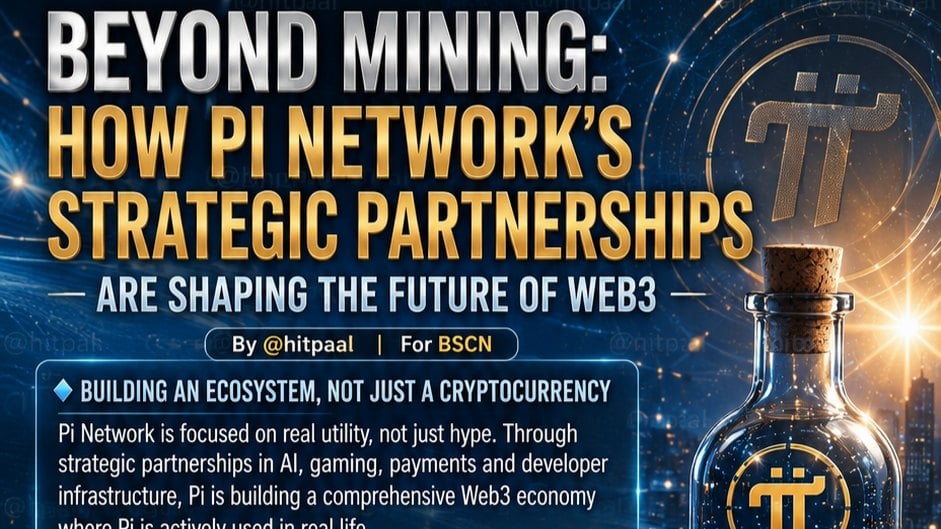
From AI to Global Payments: How Pi Network's Strategic Partnerships Could Define the Next Era of Web3
By @hitpaal | For BSCN
When blockchain projects discuss partnerships, the headlines often focus on market excitement. Yet history has shown that partnerships only matter when they create lasting utility.
Pi Network appears to be pursuing a different strategy.
Rather than announcing an extensive list of corporate alliances, the project has focused on carefully selected collaborations that strengthen core components of its ecosystem—from artificial intelligence and Web3 gaming to payment infrastructure and developer accessibility.
Although the number of officially announced partners remains relatively small, each collaboration supports a larger objective: transforming Pi Network into a practical digital economy instead of simply another cryptocurrency.
The Shift From Mining to Building
For years, Pi Network was primarily recognized for introducing mobile mining to millions of users worldwide.
As the ecosystem matured, however, the conversation gradually evolved.
Today, the network is increasingly centered on creating an environment where developers can build applications, businesses can accept Pi, merchants can reach new customers, and users can interact with decentralized services through a single ecosystem.
This transition reflects a broader philosophy.
Mining may distribute a currency, but utility creates an economy.
That philosophy is becoming increasingly visible through Pi Network's strategic collaborations.
OpenMind: Where Artificial Intelligence Meets Decentralized Infrastructure
Among Pi Network Ventures' earliest announcements, OpenMind stands out as a milestone.
Rather than representing a conventional investment, the collaboration signals Pi Network's interest in the rapidly expanding AI economy.
OpenMind focuses on decentralized artificial intelligence, enabling AI models and intelligent applications to leverage distributed computing resources.
The successful demonstration of AI workloads operating through Pi Nodes highlights an intriguing possibility: millions of decentralized nodes could eventually contribute computing resources to support next-generation AI services.
If this vision continues to mature, Pi Network may evolve beyond a payments ecosystem into a platform where verified human identity, decentralized computing, and artificial intelligence operate together.
In an era increasingly defined by AI, this represents one of Pi's most strategically important initiatives.
CiDi Games: Bringing Digital Entertainment Into the Pi Economy
Gaming has become one of the largest sectors within Web3.
Recognizing this opportunity, Pi Network partnered with CiDi Games to explore how blockchain gaming can generate meaningful economic activity.
The collaboration extends beyond digital collectibles.
Developers can build immersive gaming experiences where payments, rewards, digital ownership, and community engagement are integrated directly into gameplay.
As more developers enter the Pi ecosystem, gaming could become one of the most active channels for real-world Pi utility.
Banxa: Connecting Traditional Finance With Pi
One of blockchain's greatest challenges has always been accessibility.
For mainstream adoption to occur, users need simple and secure methods for entering decentralized ecosystems.
Banxa addresses that challenge by providing regulated fiat on-ramp services, allowing eligible users to interact with Pi through familiar payment methods.
Although infrastructure partnerships rarely receive significant attention, they often become essential building blocks for long-term ecosystem growth.
Onramper: Simplifying Global Access
Pi Network also integrated Onramper to improve accessibility across multiple payment providers.
Instead of relying on a single payment gateway, users can access various regional payment options through one streamlined interface.
This seemingly simple improvement strengthens one of Pi Network's long-term ambitions: creating an ecosystem that remains accessible regardless of geographical location.
Why Pi Is Choosing Quality Over Quantity
Many blockchain ecosystems promote hundreds of partnerships.
However, large numbers do not necessarily translate into meaningful adoption.
Pi Network appears to prioritize collaborations that directly contribute to ecosystem development.
Each official partnership serves a distinct purpose:
- OpenMind expands AI capabilities.
- CiDi Games accelerates Web3 gaming.
- Banxa strengthens payment accessibility.
- Onramper improves global onboarding.
Together, these collaborations reinforce different layers of the same digital economy.
The Growing Ecosystem Beyond Partnerships
Partnerships represent only one component of Pi Network's broader infrastructure.
The ecosystem now includes:
- Pi Browser
- Pi Wallet
- Pi App Studio
- Pi Ad Network
- Pi Domains
- Pi Commerce
- Pi Network Ventures
- Pi Ecosystem Interface
Combined, these products provide developers and businesses with tools to create applications, monetize services, verify users, and facilitate digital commerce inside a unified environment.
Where Could Pi Network Expand Next?
While the Pi Core Team has not announced additional strategic partnerships, the network's roadmap offers insight into sectors that naturally align with its long-term objectives.
Future collaborations could emerge in:
- Artificial Intelligence
- Enterprise AI infrastructure
- Global payment networks
- E-commerce platforms
- Digital identity solutions
- Creator economy applications
- Enterprise productivity software
- Decentralized cloud computing
These possibilities remain speculative, but they are consistent with Pi's publicly stated direction toward utility-driven ecosystem growth.
The Road Ahead
The success of any blockchain is ultimately determined not by market speculation but by sustained adoption.
Pi Network's current strategy suggests that long-term value may come from enabling developers, businesses, AI platforms, merchants, and users to participate in the same interconnected economy.
If future partnerships continue to strengthen infrastructure while expanding real-world utility, Pi Network could gradually position itself as more than a digital currency.
It could become a platform where verified identity, decentralized applications, artificial intelligence, digital payments, gaming, and commerce converge into a single Web3 ecosystem.
Whether that vision is fully realized will depend on execution, developer participation, and user adoption.
Yet the direction is becoming increasingly evident.
For Pi Network, partnerships are not simply announcements.
They are the foundation upon which the next chapter of its ecosystem may be built.